Autumn Budget 2026: What does it mean for you and your business?

On 28 October, Chancellor John Healey delivered his first Autumn Budget. While the main rates of Income Tax, National Insurance and VAT have largely been left alone, there are changes that could affect landlords, individuals, savers, business owners, company directors and employers.
Some changes start as soon as April 2027, while others are planned for later years. We have picked out the announcements most relevant to our clients and explained what you may need to consider.
The Budget in brief: our top 5 takeaways
- Landlords face higher tax on rental income. From April 2027, Income Tax rates on property income rise to 24%, 44% and 49%, making it important to review rental profits and future plans.
- Tax thresholds remain frozen. The Personal Allowance and higher-rate threshold remain unchanged until April 2031, while tax rates on savings income are also due to rise from April 2027.
- Small amounts of extra income get a bigger allowance. The Trading Allowance increases from £1,000 to £3,000 from April 2027, potentially helping people with small side incomes.
- Businesses and employers need to prepare. Changes include new Capital Allowances rules, a lower Business Asset Disposal Relief lifetime limit, higher minimum wage rates and the move towards mandatory payrolling of benefits.
- Pensioners and families should check the changes. A new Pension Tax Allowance is intended to remove small Income Tax bills for eligible people with income around the full new State Pension, while most unused pension funds are due to come within Inheritance Tax from April 2027.
1. Landlords: tax on rental income is going up
One of the most important announcements for landlords is an increase in the tax rates applying to property income from 6 April 2027.
| Tax band | Current rate | From April 2027 |
|---|---|---|
| Basic rate | 20% | 24% |
| Higher rate | 40% | 44% |
| Additional rate | 45% | 49% |
These rates apply to property income in England, Wales and Northern Ireland. Scotland has different Income Tax rules.
The increase is on top of changes announced previously, so landlords could see a noticeable difference in their tax bills. The extra tax will depend on your rental profit and your overall income.
What about mortgage interest?
The way mortgage interest relief is calculated for individual landlords will also change. From 2027/28, the basic-rate tax reduction for qualifying finance costs will be calculated at 24%.
Individual landlords will continue to receive a tax reduction rather than deducting the interest directly from their rental profits.
The Property Allowance
The £1,000 Property Allowance remains unchanged. It can be useful for people with small amounts of property income, although whether it is better than claiming actual expenses depends on the circumstances.
It is separate from the Trading Allowance, which is increasing to £3,000 (see section 4).
Should you hold property personally or through a company?
With tax on personally owned rental profits increasing, some landlords may be considering whether to hold properties through a limited company.
However, transferring an existing property into a company can trigger Capital Gains Tax, Stamp Duty Land Tax and legal costs, as well as mortgage and refinancing issues. Companies are taxed differently, and tax may also be payable when profits are eventually withdrawn.
There is no one-size-fits-all answer. Before making changes, it is worth looking at the whole picture, including your mortgage, other income, future plans and how you intend to use the rental profits.
Landlords should also make sure that rental income and expenses are recorded accurately. HMRC continues to improve the information it receives about property income, so good records and correctly completed tax returns remain important.
2. Personal tax: frozen thresholds and higher tax on savings
There is no increase to the main rates of Income Tax on employment income, but the main tax thresholds remain frozen until April 2031.
The key thresholds remain:
- Personal Allowance: £12,570
- Higher-rate threshold: £50,270
- Additional-rate threshold: £125,140
As wages, pensions and other income increase over time, more people may find themselves paying tax at a higher rate, or paying tax on income that was previously covered by their Personal Allowance. This is often called fiscal drag and is a real burden to taxpayers.
Tax on savings income
From 6 April 2027, the tax rates on savings income will increase by two percentage points:
| Tax band | Current rate | From April 2027 |
|---|---|---|
| Basic rate | 20% | 24% |
| Higher rate | 40% | 44% |
| Additional rate | 45% | 49% |
The change will not affect everyone in the same way. Many people have a Personal Savings Allowance, and some savings income may fall within the starting rate for savings. Savings held in ISAs remain tax-free, subject to the ISA rules.
If you have substantial savings outside an ISA, it may be worth reviewing how your interest is taxed and whether you are making use of the allowances available to you.
Dividends
Dividend tax rates are unchanged by this Budget. The Dividend Allowance also remains £500.
Company directors who take a combination of salary and dividends should continue to review their overall remuneration, taking account of their other income and the company’s circumstances.
Capital Gains Tax
The annual exempt amount for Capital Gains Tax remains £3,000. The main CGT rates remain 18% and 24%, depending on the type of asset and the individual’s circumstances.
If you are planning to sell investments, a second property or other assets, it is worth checking the likely tax position before proceeding.
3. ISAs and first-time buyers
There was some welcome news for savers: the planned reduction in the Cash ISA allowance has been cancelled.
The overall ISA allowance remains £20,000 per tax year from April 2027. This can be shared between eligible ISA types, including Cash ISAs and Stocks and Shares ISAs.
A new First Time Buyer ISA is planned for April 2029. It is intended to help eligible first-time buyers save towards a home, with a government bonus of 25% of the final account balance, up to a maximum bonus of £20,000. The scheme is intended for a qualifying first home costing up to £450,000, subject to the final rules.
Existing Lifetime ISA holders will be able to continue contributing to and using their accounts under the current rules.
The Government has also announced a reduction in the Lifetime ISA withdrawal charge for certain withdrawals to buy a property above the existing £450,000 property-price limit. The charge is due to fall from 25% to 20% from 29 October 2026. The rules are specific, so check your position before withdrawing money.
If you are saving for a first home, it is worth checking which account is most suitable for your circumstances rather than assuming a new scheme will automatically be better.
4. Small businesses and company owners
Trading Allowance increases to £3,000
From 6 April 2027, the Trading Allowance will increase from £1,000 to £3,000 a year.
This allowance covers certain small amounts of trading and miscellaneous income. For example, it may be useful for people earning extra income from occasional services or small trading activities alongside employment or retirement.
The increase means individuals will be able to receive up to £3,000 of qualifying trading and miscellaneous income tax-free each year, subject to the rules.
The allowance cannot simply be used against every type of income. In particular, it is separate from the £1,000 Property Allowance for small amounts of property income.
If you have expenses, you should also consider whether using the allowance or claiming actual expenses is more beneficial.
Capital allowances and investment
There are changes to the tax relief available when businesses invest in certain equipment and machinery.
From 1 January 2027, the main-rate First Year Allowance will increase from 40% to 50% for qualifying expenditure.
However, from April 2027, the main rate of Writing Down Allowance will fall from 14% to 12%. The special-rate pool remains at 6%.
Full expensing and the £1 million Annual Investment Allowance continue to provide full upfront relief for many qualifying purchases, subject to the relevant conditions.
The rules depend on the type of asset and your business structure. If you are planning a significant purchase, it is worth checking which allowance applies and when the expenditure is incurred before making a decision.
Selling your business
If you are thinking about selling your company or business, the lifetime limit for Business Asset Disposal Relief (BADR) is reducing from £1 million to £500,000 for qualifying disposals from 6 April 2027.
BADR provides a reduced Capital Gains Tax rate on qualifying business disposals. The rate is due to be 18%, but the lower lifetime limit means that a greater proportion of a qualifying gain could be taxed at the normal Capital Gains Tax rate.
A new Founders’ Relief is also planned for certain qualifying owners of high-growth, innovative companies. It is intended to provide a 10% CGT rate on up to £10 million of lifetime gains, but the eligibility conditions are restrictive. It is not a straightforward replacement for BADR and is unlikely to apply to our clients.
If you are planning to sell shares, retire from your business or pass it on, timing and eligibility may be important. Do not assume that a sale will qualify automatically, as the detailed conditions need to be met.
Company distributions and succession planning
The Budget also includes planned changes to the tax treatment of certain company distributions, including some share buybacks and capital reduction arrangements, from April 2028.
These rules may affect business owners considering a company sale, restructuring or succession planning. The detail is still developing, so anyone considering a significant transaction should take advice before committing to a structure.
For most owner-managed companies, the usual considerations remain important: how much to take as salary or dividends, how much profit to retain in the company, and how to plan for future investment or retirement.
5. Making Tax Digital for Income Tax
Making Tax Digital (MTD) for Income Tax is still going ahead.
From April 2027, qualifying sole traders and landlords with gross qualifying income above £30,000 will generally need to keep digital records and send quarterly updates to HMRC using compatible software. The threshold is based on qualifying income, not profit.
This is separate from the existing requirement to submit a Self Assessment tax return. Quarterly updates do not replace the annual tax return and existing clients have been emailed separately about MTD.
There will be a relaxation of late-submission penalty points for quarterly updates during the first year for those joining in April 2027, but the requirement to keep digital records and send updates remains.
6. Employers and payroll
There are several changes for employers to be aware of.
National Minimum Wage
The National Minimum Wage and National Living Wage rates are due to increase from 1 April 2027.
| Age or category | Rate from April 2027 |
|---|---|
| Age 21 and over | £13.21 |
| Age 18–20 | £11.27 |
| Under 18 and eligible apprentices | £8.31 |
The accommodation offset will also rise to £11.53 per day.
Employers should check their payroll systems and budgets ahead of the new rates taking effect.
Payrolling benefits
The Government is moving towards mandatory payrolling of most benefits in kind.
From April 2027, this will include benefits such as company cars, vans, fuel and private medical benefits. Most other benefits and taxable expenses are expected to follow from April 2028, with some exclusions.
This means employers will need to consider how benefits are recorded and taxed through payroll, rather than relying on the current reporting arrangements alone. Payroll systems and internal processes may need updating.
Company car tax
Company car tax rates are changing over the coming years. For 2030/31, rates are planned to be one percentage point higher than in 2029/30, subject to the relevant vehicle categories and limits.
If you provide company cars, particularly electric vehicles, it is worth considering the future tax costs as part of your overall benefits planning.
Mileage rates
The tax-free mileage rate for cars and vans has increased to 55p per mile for the first 10,000 business miles from 6 April 2026. From 6 April 2027, the rate for business miles above 10,000 will increase from 25p to 35p per mile.
These rates are relevant to employers reimbursing employees for business journeys in their own vehicles. They also apply to self-employed people using the simplified mileage method where the rules allow.
If you pay mileage expenses or use mileage rates in your business records, check that your policy and processes reflect the correct rates and dates.
Business travel and expenses
New benchmark subsistence rates are planned from April 2028 for qualifying business travel:
- £20 for qualifying travel lasting more than five hours
- £60 for qualifying travel lasting more than ten hours
- £75 for qualifying travel lasting 24 hours or more
The conditions for claiming these amounts will apply, so they should not be treated as automatic allowances for every journey.
The £2,500 threshold relating to employment expenses claimed through Self Assessment is also due to be removed from April 2028. This should make it easier for eligible employees to claim tax relief on unreimbursed employment expenses through PAYE, subject to the relevant rules.
7. Pensions and inheritance tax
Pension Tax Allowance: good news for some pensioners
From 6 April 2027, a new Pension Tax Allowance will help eligible people of State Pension age avoid paying small amounts of Income Tax on their pension-level income.
The full new State Pension is expected to be £13,036.40 a year in 2027/28, which is above the standard Personal Allowance of £12,570. This can leave someone receiving only the full new State Pension with a small Income Tax bill.
The new allowance is designed to remove that tax bill for eligible people whose total income is up to the value of the full new State Pension. Those with slightly higher incomes may still receive some relief, but it gradually reduces and disappears once total income reaches £13,319 in 2027/28.
Importantly, eligibility is based on being over State Pension age and on total income, not on whether someone actually receives the State Pension. Someone of State Pension age with a small private pension or other income could therefore qualify too.
The allowance is expected to apply for the 2027/28, 2028/29 and 2029/30 tax years. It is intended to be applied automatically, so eligible people should not normally need to make a separate claim.
If you have elderly parents or relatives with income just above the Personal Allowance, this is worth being aware of when reviewing their tax position. The allowance is relatively small, but it could remove the need for some pensioners to pay a small tax bill.
Inheritance Tax and pensions
Most unused pension funds and pension death benefits are due to come within the scope of Inheritance Tax from 6 April 2027.
This could affect estate planning for people who have built up pension funds and expected unused funds to pass outside their estate for Inheritance Tax purposes.
If you are reviewing your will, pension nominations or wider estate planning, it is worth considering this change alongside your other assets and liabilities.
8. VAT and other business changes
E-invoicing
Mandatory e-invoicing for relevant VAT transactions is planned from April 2029. Further details and technical requirements are expected, but businesses should be aware that invoicing and record-keeping processes may need to change.
Overseas services and the VAT reverse charge
From April 2027, changes to the reverse charge for certain overseas services will affect UK customers who are VAT registered.
The treatment can depend on the type of service and whether the customer is VAT registered. Businesses purchasing services from overseas suppliers should check the VAT treatment rather than assume the supplier’s invoice is correct for UK purposes.
Deposit Return Scheme
The Deposit Return Scheme for eligible single-use plastic bottles and metal cans is planned to launch on 1 October 2027 in England, Scotland and Northern Ireland.
It is most relevant to businesses producing or selling affected drinks. Those businesses should monitor the requirements as implementation approaches.
9. Property owners and household support
High Value Council Tax Surcharge
From April 2028, an annual charge is planned for residential properties in England valued at £2 million or more. It starts at £2,500 for properties valued between £2 million and £2.5 million, rising for more valuable properties.
This is unlikely to affect most of our clients, but owners of high-value homes should look out for further details.
£100 Household Energy Payment
From January 2027, eligible households in England whose main home is in Council Tax bands A to D and who are liable for Council Tax are expected to receive a one-off £100 payment towards energy costs.
Those who pay Council Tax by direct debit are expected to receive the payment directly, while others will be given details of how to apply. Second homes and empty properties are excluded, and further eligibility guidance is expected.
10. HMRC payments and administration
The Government plans to change how some Self Assessment tax bills are paid from April 2029. The aim is to move people who currently make payments on account towards smaller, more regular payments during the year.
People with sufficient PAYE income may also be able to have forecast tax collected through their PAYE deductions. The detailed arrangements will depend on individual circumstances.
The normal Self Assessment filing deadline is not being replaced by these changes, so taxpayers will still need to submit their returns on time.
Businesses will also generally need to have a Direct Debit instruction in place for VAT and PAYE liabilities from April 2029, subject to exceptions. Other payment methods are expected to remain available before a specified cut-off date, with Direct Debit used to collect any unpaid balance.
HMRC is also planning stronger measures around correcting tax return errors. Taxpayers may have a greater responsibility to take action when they become aware that a return or other submission contains an inaccuracy.
Keeping good records and dealing with errors promptly will remain important.
What should you do now?
Not every Budget announcement will affect every taxpayer or business. For most of our clients, the key actions are to:
- Landlords: review expected rental profits and the impact of higher property income tax rates from April 2027.
- Individuals and savers: check how frozen tax thresholds and the changes to savings income may affect you.
- People with small amounts of extra income: check whether the increased £3,000 Trading Allowance could simplify your tax position.
- Company directors: review planned investment, dividend and business exit decisions before making significant changes.
- Employers: prepare for minimum wage increases and the move towards payrolling benefits.
- Sole traders and landlords affected by MTD: check your qualifying income and start preparing for digital records and quarterly updates if required.
- Anyone planning for retirement or inheritance: consider the Pension Tax Allowance and pension Inheritance Tax changes as part of your wider planning.
If you would like to understand how the Budget affects you personally or your business, please get in touch with Moore Accountancy. We can help you identify the changes that matter to you and plan ahead.
This article summarises selected announcements from the Autumn Budget on 28 October 2026, based on information available at 29 October 2026. Some measures remain subject to legislation, consultation or further guidance. It is intended as a general guide and should not be relied upon as advice for individual circumstances.
News
On 28 October, Chancellor John Healey delivered his first Autumn [...]
The processes involved in bookkeeping and accounting frequently overlap—after all, [...]
Bookkeeping is a vital part of running any business, but [...]
Discover which business expenses you can claim as a UK sole trader or limited company. This guide explains allowable expenses, HMRC rules, and how to reduce your tax bill legally.
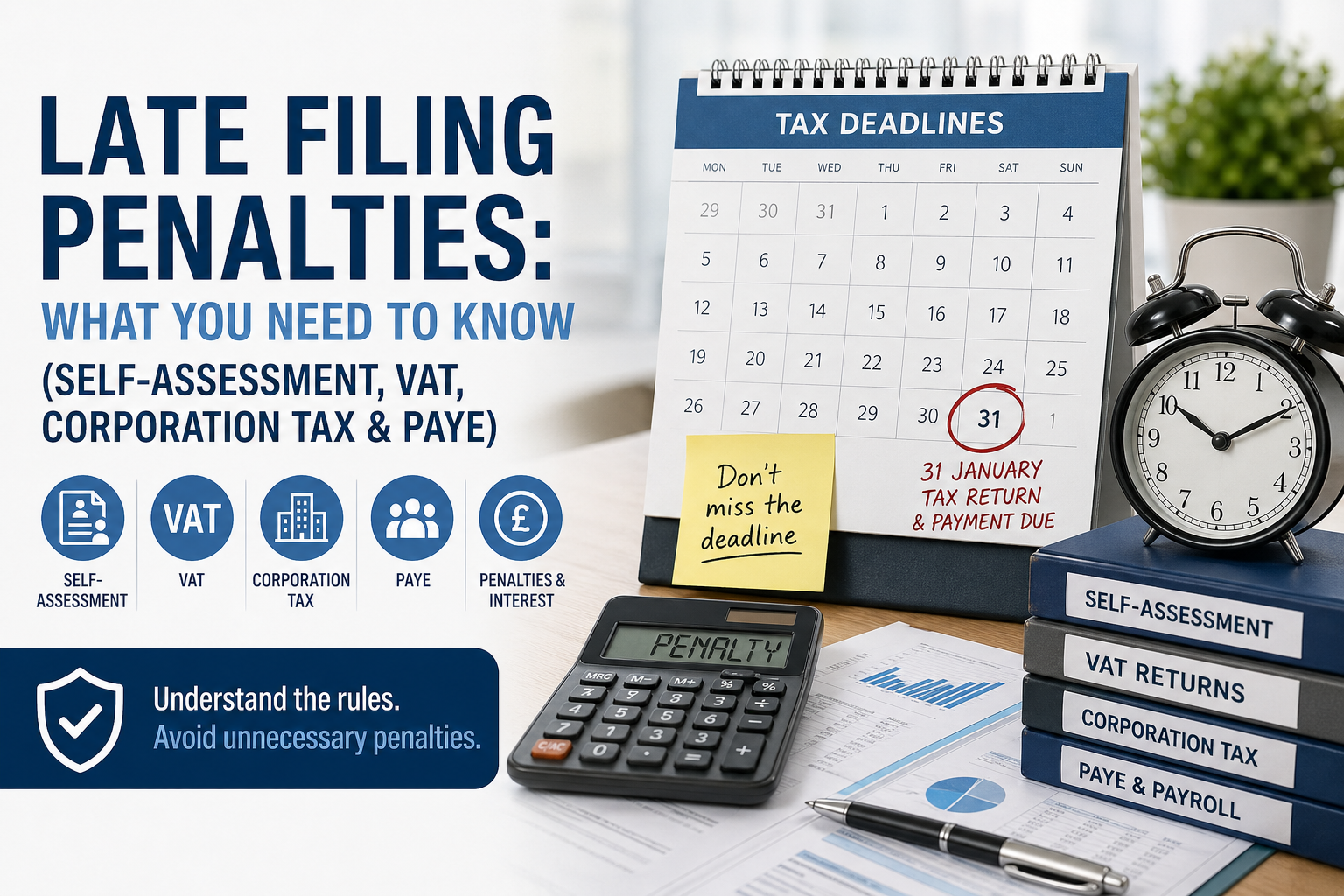
Late Filing Penalties: What You Need to Know (Self-Assessment, VAT, [...]