Late Filing Penalties: What You Need to Know (Self-Assessment, VAT, Corporation Tax & PAYE)
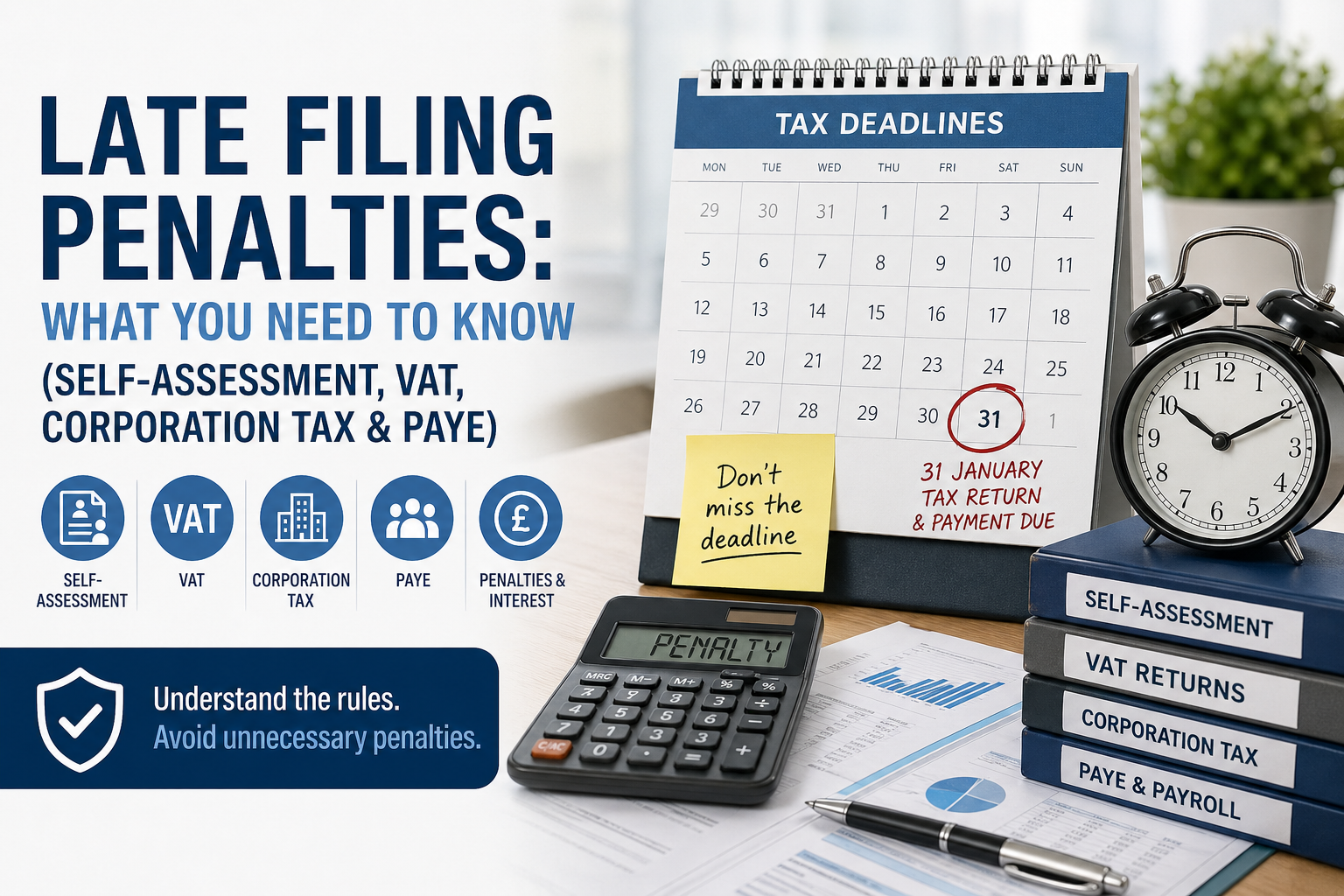
Late Filing Penalties: What You Need to Know (Self-Assessment, VAT, Corporation Tax & PAYE)
Missing a tax deadline can be stressful, and HMRC penalties can quickly add up if things aren’t dealt with promptly. Whether you’re a sole trader, landlord, or limited company director, it’s important to understand what the penalties are, when they apply, and what you can do if you’ve fallen behind.
In this post, we break down the late filing penalties for Self-Assessment, VAT returns, and Corporation Tax in plain English.
Self-Assessment – Late Filing and Late Payment Penalties
HMRC applies separate charges for filing late and paying late under Self-Assessment. It’s possible to be charged both at the same time, so it’s important to understand how each works.
Key deadlines
- 31 January – Online tax return deadline and tax payment due
- 31 October – Paper tax return deadline (much less common now)
Late Filing: Fixed Penalties & Points
For those not yet in Making Tax Digital (MTD), the traditional fixed penalties apply:
- 1 day late: £100 fixed penalty (even if no tax is owed).
- 3 months late: £10 per day, up to a maximum of £900.
- 6 months late: £300 or 5% of the tax due (whichever is higher).
Note for 2026: If you are a landlord or sole trader with income over £50,000, you are now under the Points System. You receive 1 point per late filing; a £200 fine is triggered once you reach 4 points (quarterly filers) or 2 points (annual filers).
Late Payment: Fixed % vs. Variable Interest
If your tax is paid late, you face two distinct types of charges:
- Late Payment Penalties (Fixed %): These are “lump sum” charges based on how long the debt has been outstanding:
- 30 days late: 5% of the unpaid tax.
- 6 months late: An additional 5% of the unpaid tax.
- 12 months late: A further 5% of the unpaid tax.
- Late Payment Interest (Variable %): This is charged daily from 1 February.
As of April 2026, the rate is 7.75% (Bank of England Base Rate + 4%). This continues to accrue until the bill is settled in full.
💡 If you can’t pay by 31 January, it’s still worth filing the return on time. This avoids late filing penalties and limits the initial charges to interest only.
VAT – Late Submission & Late Payment Penalties
VAT now operates under HMRC’s points-based penalty system, which applies to VAT periods starting from January 2023.
Late submission penalties
- Each late VAT return earns 1 penalty point
- Once you reach the threshold, you receive a £200 penalty
Thresholds depend on how often you submit returns:
- Quarterly VAT returns – 4 points
- Monthly VAT returns – 5 points
- Annual VAT returns – 2 points
Points only reset once all outstanding returns are submitted and you maintain a period of full compliance.
Late payment charges
If VAT is paid late, HMRC applies two separate charges, similar to Self-Assessment:
Interest
- Charged from the day after the VAT payment due date
- Calculated as a percentage of the unpaid VAT
- Continues to accrue until the VAT is paid in full
Interest applies regardless of how late the payment is.
Late payment penalties
Late payment penalties only apply once VAT has been unpaid for a set period:
- Up to 15 days late – No penalty (if paid in full or a Time to Pay arrangement is agreed)
- 16–30 days late – 2% of the VAT outstanding at day 15
- 31 days or more – 2% of the VAT outstanding at day 15 plus, a further 2% of the VAT outstanding at day 30
- Daily Charge: From day 31, a daily penalty also accrues at an annual rate of 4%.
These penalties are charged in addition to ongoing interest until the VAT is paid in full.
Corporation Tax – Late Filing Penalties
Limited companies must file their Corporation Tax return (CT600) within 12 months of the end of their accounting period. However, the tax itself is usually due 9 months and 1 day after the year end.
Penalties for late CT600 filings – many of these doubled as of 1/4/26
- 1 day late – £200 (previously £100)
- 3 months late – A further £200 (previously another £100)
- 6 months late – HMRC may estimate your Corporation Tax bill and add a 10% penalty to that estimate
- 12 months late – A further 10% penalty of the unpaid Corporation Tax
If your company files late three times in a row, the £200 penalties increase to £1,000 each (previously £100 penalties increase to £500 each).
Late payment of Corporation Tax will also trigger interest charges, even if the return itself is filed on time.
Companies House – Late Filing Penalties (Annual Accounts)
It’s important to note that Companies House penalties are separate from HMRC penalties. Even if your Corporation Tax position is up to date, filing annual accounts late at Companies House can still result in fines and, in serious cases, legal consequences for directors.
Late Filing Penalties for Annual Accounts (Private Limited Companies)
If annual accounts are filed late, Companies House automatically charges penalties based on how late the accounts are delivered:
- Up to 1 month late – £150
- More than 1 month but up to 3 months late – £375
- More than 3 months but up to 6 months late – £750
- More than 6 months late – £1,500
Repeat Late Filings
If a company files its accounts late two years in a row, the penalty amounts are automatically doubled for the second year.
This section applies specifically to late submission of annual accounts. There is no automatic financial penalty for late confirmation statements (CS01) in the same way — however, failure to file confirmation statements at all can lead to enforcement action or potential company strike‑off.
Directors remain personally responsible for ensuring accounts are filed on time, and failing to file accounts by the deadline is also a criminal offence under UK law.
PAYE – Late Filing Penalties
Unlike Corporation Tax or VAT, PAYE late filing penalties work slightly differently.
HMRC do not charge interest simply because your payroll submission is late. Instead, they apply a fixed monthly penalty, based on the size of your payroll scheme.
Understanding how this works can help you avoid unnecessary costs.
What will trigger a PAYE late filing penalty?
You may receive a penalty if:
- The full payment submission (FPS) was late
- The expected number of FPSs are not sent for any given period
- An EPS (Employer Payment Summary) is not sent when you did not pay any employees in any given pay period
When will HMRC not charge a penalty?
There are a few important exceptions:
- The FPS is late but all reported payments on the FPS are within 3 days of the employee’s payday
- A new employer sends their first FPS within 30 days of paying an employee
- It is the first failure in the tax year to send a report on time (this does not apply to employers who register with HMRC as an annual scheme)
How much is the late filing penalty?
The penalty amount depends on the number of employees you have in your PAYE scheme.
| Number of Employees | Monthly Penalty |
| 1 to 9 | £100 |
| 10 to 49 | £200 |
| 50 – 249 | £300 |
| 250+ | £400 |
What happens if you are over 3 months late?
If you as an employer are over 3 months late you will be charged an additional 5% of the tax and NI that you should have reported.
This does not include late payment fees and if you have multiple PAYE submissions due you will be charged the penalties for each late PAYE submission
Late Payment Charges (Separate from filing penalties)
Separate to the late filling penalties, if you pay the Tax and NI late to HMRC you will also have charges.
These fees change based on the Bank of England’s base rate, and as of April 2026 are 7.75%.
How is late payment interest calculated?
Currently, the base rate is 3.75% (this is due to change on 19th March 2026) and HMRC add a 4% charge on to this. To figure out how much interest you will be charged per day you will need to do the following calculation:
Base Rate + 4% = Total Late Payment Interest.
So currently this would mean:
3.75 + 4 = 7.75%
Can Penalties Be Appealed?
Yes – HMRC may cancel penalties if you have a reasonable excuse, such as:
- Serious illness or bereavement
- Unexpected hospital stays
- System failures outside your control
Missing deadlines due to forgetfulness, pressure of work, or not knowing the rules is unlikely to be accepted.
Appeals usually have strict time limits, so it’s important to act quickly.
How We Can Help
Late filing penalties are often avoidable with the right systems and reminders in place. We help our clients stay compliant by:
- Monitoring deadlines
- Preparing and submitting returns on time
- Dealing with HMRC queries and appeals where appropriate
If you’re worried about missed deadlines or want help staying on top of your tax obligations, feel free to get in touch.
News
Discover which business expenses you can claim as a UK sole trader or limited company. This guide explains allowable expenses, HMRC rules, and how to reduce your tax bill legally.
Late Filing Penalties: What You Need to Know (Self-Assessment, VAT, [...]
Taking Money Out of Your Company: The Comprehensive Guide to [...]
Nobody likes a brown envelope from HMRC, especially one containing [...]
What Expenses Can I Claim? A Guide for the Self-Employed [...]