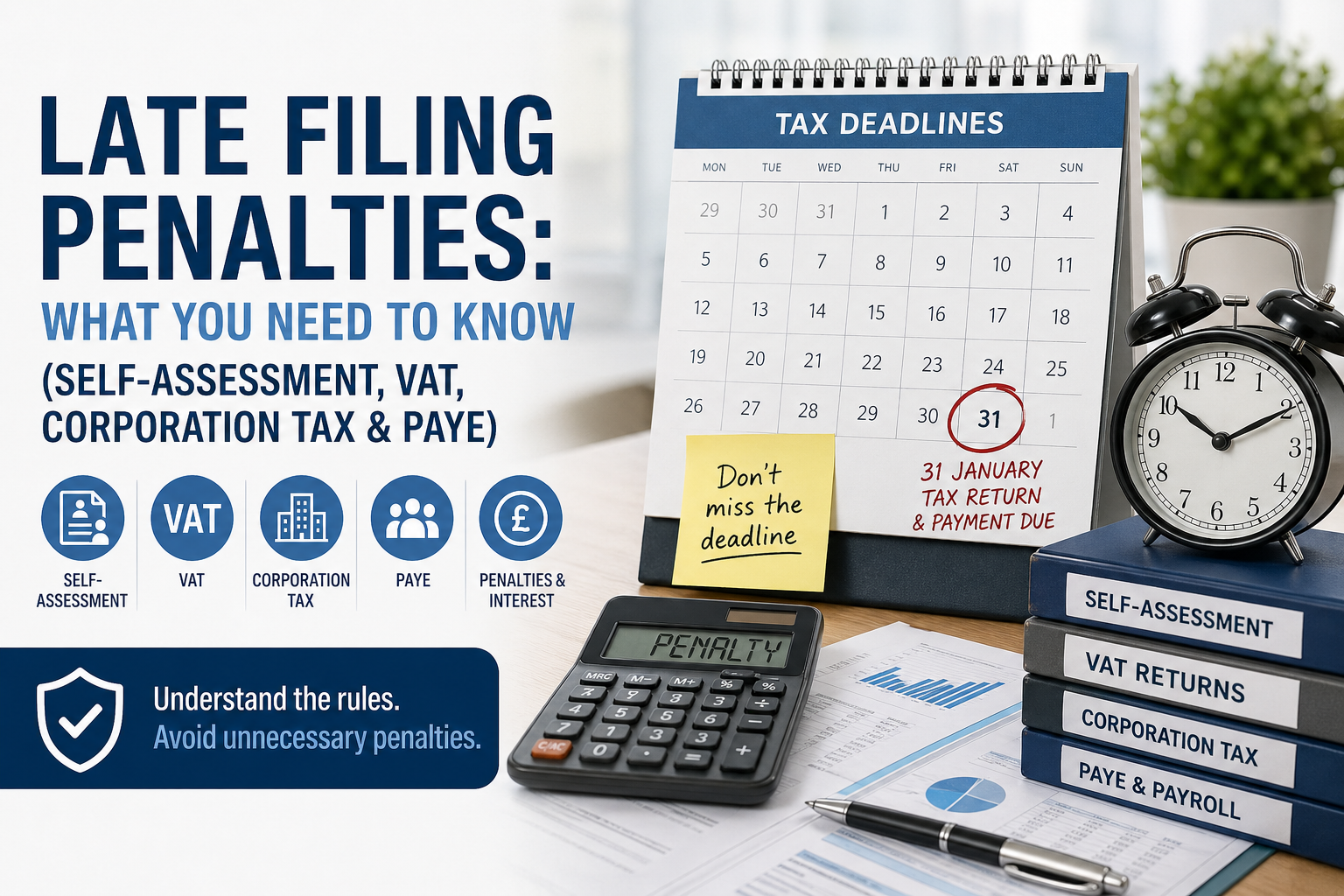
Late Filing Penalties: What You Need to Know (Self-Assessment, VAT, Corporation Tax & PAYE)
Nobody likes a brown envelope from HMRC, especially one containing a penalty notice. Missing a deadline is easily done when you’re busy running a business, but the costs can mount up quickly. Whether you’re a sole trader, a landlord, or a limited company director, it’s important to understand the rules so you aren’t caught out.
In this post, we break down the late filing penalties for Self-Assessment, VAT, and Corporation Tax in plain English.
Self-Assessment – Late Filing and Late Payment Penalties
HMRC applies separate charges for filing late and paying late. It is quite possible to be charged both at the same time, so it’s important to understand how each works.
Late filing penalties
If you submit a Self-Assessment tax return late, HMRC will charge penalties even if there is no tax to pay.
Key deadlines
- 31 January – Online tax return deadline and tax payment due
- 31 October – Paper tax return deadline (much less common now)
Penalties for late filing
- 1 day late – £100 fixed penalty
- 3 months late – £10 per day, up to a maximum of £900
- 6 months late – £300 or 5% of the tax due (whichever is higher)
- 12 months late – Another £300 or 5% of the tax due
If your Self-Assessment tax is paid late, HMRC applies late payment interest and penalties:
Interest:
- Charged daily from 1 February (the day after the payment deadline)
- Calculated as a percentage of the unpaid tax
- Continues to accrue until the tax is paid in full
Interest applies regardless of how late the payment is, even if it is only one day overdue.
As of February 2026, the late payment interest rate is 7.75% (calculated as the Bank of England base rate of 3.75% + 4%).
Late payment penalties (fixed percentages)
These are separate from interest and only apply if the tax remains unpaid for a certain period:
- 30 days late – 5% of the unpaid tax
- 6 months late – An additional 5% of the unpaid tax
- 12 months late – A further 5% of the unpaid tax
These penalties are added on top of the ongoing interest charges.
💡 If you can’t pay by 31 January, it’s still worth filing the return on time. This avoids late filing penalties and limits the initial charges to interest only.
VAT – Late Submission & Late Payment Penalties
VAT now operates under HMRC’s points-based penalty system, which applies to VAT periods starting from January 2023.
Think of it like a driving licence—you only get a fine when you’ve collected too many points.
Late submission penalties
- Each late VAT return earns 1 penalty point
- Once you reach the threshold, you receive a £200 penalty
Thresholds depend on how often you submit returns:
- Quarterly VAT returns – 4 points
- Monthly VAT returns – 5 points
- Annual VAT returns – 2 points
Points only reset once all outstanding returns are submitted and you maintain a period of full compliance.
Late payment charges
If VAT is paid late, HMRC applies two separate charges, like Self-Assessment:
Interest
- Charged from the day after the VAT payment due date
- Calculated as a percentage of the unpaid VAT
- Continues to accrue until the VAT is paid in full
Interest applies regardless of how late the payment is, and is currently 7.75%
Late payment penalties
Late payment penalties only apply once VAT has been unpaid for a set period:
- Up to 15 days late – No penalty (if paid in full or a Time to Pay arrangement is agreed)
- 16–30 days late – 2% of the VAT outstanding at day 15
- 31 days or more – A further 2% of the VAT outstanding at day 30, plus a daily penalty (at an annual rate of 4%) on the outstanding amount.
These penalties are charged in addition to ongoing interest until the VAT is paid in full.
Corporation Tax – Late Filing Penalties
Limited companies usually have two different deadlines: you pay the tax 9 months and 1 day after your year-end, but you have 12 months to file the actual return (CT600).
Penalties for filing the CT600 late:
- 1 day late: £100.
- 3 months late: Another £100.
- 6 months late: HMRC will estimate your tax bill and add a 10% penalty.
- 12 months late: A further 10% of the unpaid tax.
If your company files late three times in a row, those £100 fines increase to £500 each.
Late payment of Corporation Tax will also trigger interest charges, even if the return itself is filed on time.
Companies House – Late Filing Penalties (Annual Accounts)
It is a common mistake to think that because your HMRC tax return is sorted, you’re in the clear. Companies House and HMRC are separate entities, and they both have their own deadlines.
Companies House is particularly strict; there is no “soft landing” or grace period. If your annual accounts are even one day late, a penalty is triggered automatically. Unlike HMRC, they rarely accept excuses for late filing unless there is an exceptional, documented reason (like a fire or flood at a critical time).
Penalties for Annual Accounts (Private Limited Companies)
If annual accounts are filed late, Companies House automatically charges penalties based on how late the accounts are delivered:
- Up to 1 month late – £150
- More than 1 month but up to 3 months late – £375
- More than 3 months but up to 6 months late – £750
- More than 6 months late – £1,500
Repeat Late Filings
If you file late two years in a row, these fines are automatically doubled. For a micro-business, a £3,000 fine for being six months late is a painful and entirely avoidable hit to your cash flow.
This section applies specifically to late submission of annual accounts. There is no automatic financial penalty for late confirmation statements (CS01) in the same way — however, failure to file confirmation statements at all can lead to enforcement action or potential company strike‑off.
PAYE – Late Filing Penalties
Unlike Corporation Tax or VAT, PAYE operates on a “month-by-month” basis. If you fall behind, you aren’t just hit with one fine—you can face three separate types of charges simultaneously.
Understanding the difference between a filing penalty, a payment penalty, and interest is the best way to keep your costs down.
Late Filing Penalties
What will trigger a PAYE late filing penalty?
You may receive a penalty if:
- The full payment submission (FPS) was late
- The expected number of FPSs are not sent for any given period
- An EPS (Employer Payment Summary) is not sent when you did not pay any employees in any given pay period
When will HMRC waive a penalty?
There are a few important exceptions:
- The FPS is late but all reported payments on the FPS are within 3 days of the employee’s payday
- A new employer sends their first FPS within 30 days of paying an employee
- It is the first failure in the tax year to send a report on time (this does not apply to employers who register with HMRC as an annual scheme)
How much is the late filing penalty?
The penalty amount depends on the number of employees you have in your PAYE scheme.
| Number of Employees | Monthly Penalty |
| 1 to 9 | £100 |
| 10 to 49 | £200 |
| 50 – 249 | £300 |
| 250+ | £400 |
What happens if you are over 3 months late?
If you as an employer are over 3 months late you will be charged an additional 5% of the tax and NI that you should have reported.
This does not include late payment fees and if you have multiple PAYE submissions due you will be charged the penalties for each late PAYE submission.
Late Payment Penalties
Separate from filing the paperwork, you must also pay the Tax and NI you owe.
- Like filing, the first late payment in a tax year is generally ignored. After that, penalties apply based on how many times you are late in a single year:
- 1 to 3 defaults: No penalty.
- 4 to 6 defaults: 1% of the late amount.
- 7 to 9 defaults: 2% of the late amount.
- 10+ defaults: 4% of the late amount.
- The 6-Month Mark: If you still haven’t paid after 6 months, a further 5% is added, with another 5% after 12 months.
Late Payment Interest
This is the interest HMRC charges for “borrowing” their money. Unlike the penalties above, there is no first-time grace period for interest.
- The Rate: As of early 2026, the rate is 7.75% (calculated as the Bank of England Base Rate of 3.75% + 4%).
- The Calculation: Interest is simple (not compounded) and is applied to the original debt from the day it was due until the day it is paid.
Can Penalties Be Appealed?
Yes—but HMRC has heard it all before. Usually, “I forgot” or “I was busy” won’t cut it. To win an appeal, you need a “Reasonable Excuse,” such as:
- Serious illness or bereavement.
- An unexpected hospital stay.
- A major IT failure on HMRC’s side.
Appeals must usually be made within 30 days, so if you’ve been hit with a fine, don’t sit on it.
How We Can Help?
Late filing penalties are often avoidable with the right systems and reminders in place. We help our clients stay compliant by:
- Monitoring deadlines
- Preparing and submitting returns on time
- Dealing with HMRC queries and appeals where appropriate
If you’re worried about missed deadlines or want help staying on top of your tax obligations, feel free to get in touch.
News
The processes involved in bookkeeping and accounting frequently overlap—after all, [...]
Bookkeeping is a vital part of running any business, but [...]
Discover which business expenses you can claim as a UK sole trader or limited company. This guide explains allowable expenses, HMRC rules, and how to reduce your tax bill legally.
Late Filing Penalties: What You Need to Know (Self-Assessment, VAT, [...]
Taking Money Out of Your Company: The Comprehensive Guide to [...]